
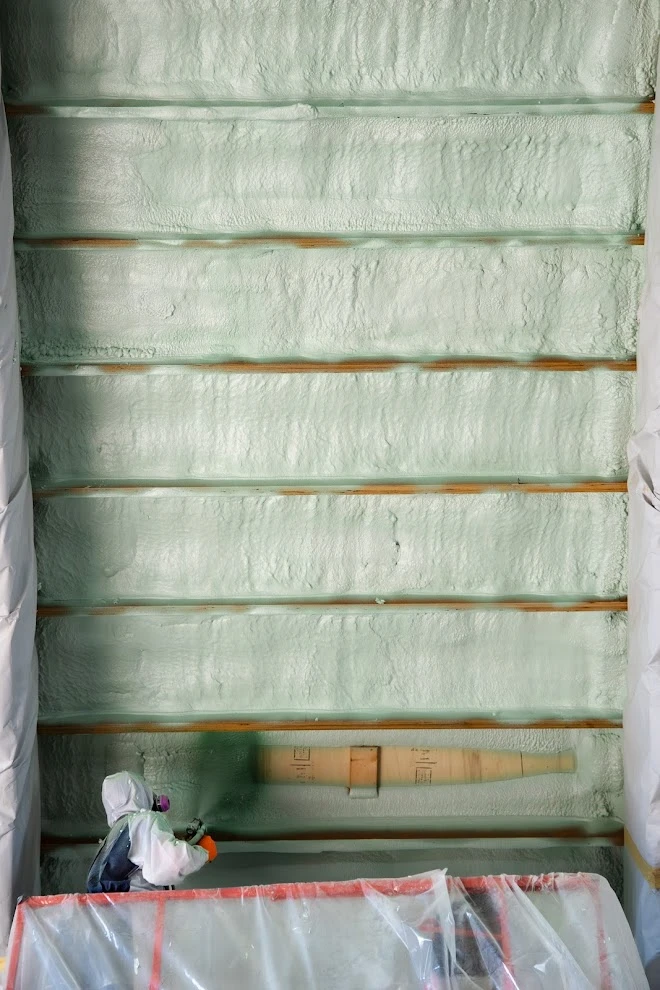
Builders in Otsego, Minnesota, are increasingly turning to spray foam insulation to meet code requirements, reduce energy waste, and deliver homes that feel noticeably more comfortable and durable than those built with traditional fiberglass batts. Otsego sits in Climate Zone 6, where heating and cooling account for the largest share of household energy use, and Minnesota’s residential energy code demands minimum R-values of R-49 for ceilings, R-20 for wood frame walls, and R-15 for crawl space walls. Spray foam insulation helps builders hit those targets with less material, while simultaneously creating an air barrier that fiberglass simply cannot provide on its own. The result is a home that costs less to operate, resists moisture damage better, and commands stronger resale appeal. These benefits are a major reason why many contractors choose professional spray foam insulation installation for new construction projects.
Otsego, MN, falls within Minnesota’s Climate Zone 6, one of the coldest residential climate zones in the continental United States. The area experiences heavy heating degree days, meaning furnaces run for a significant portion of the year, and even brief summers bring humidity that demands effective moisture management. According to the U.S. Energy Information Administration, the West North Central Census Division consistently ranks among the highest in the nation for heating degree days, making insulation quality one of the most impactful building decisions a builder can make.
Homes in cold climates lose heat through every unsealed crack, gap, and penetration in the building envelope. Traditional insulation like fiberglass batts slows conductive heat transfer, but it does not stop air movement through the material itself. The Department of Energy notes that heating and cooling account for 50 to 70% of energy used in the average American home, and that inadequate insulation and air leakage are the leading causes of energy waste. For builders working in Otsego, these factors directly affect homeowner satisfaction and long-term operating costs.
The primary advantage of spray foam insulation is that it combines thermal resistance with air sealing in a single step. When sprayed into wall cavities, attics, rim joists, and crawl spaces, the foam expands to fill every void, gap, and irregular shape, creating a continuous barrier against both heat loss and air infiltration. These performance benefits help explain why many builders improve construction profitability with spray foam while delivering more energy-efficient homes.
| Insulation Type | R-Value Per Inch | Air Barrier | Moisture Resistance | Best Application |
|---|---|---|---|---|
| Closed-cell spray foam | R-6 to R-7 | Yes (impermeable) | High | Walls, crawlspaces, rim joists, foundations |
| Open-cell spray foam | R-3 to R-3.5 | Yes (permeable) | Low to moderate | Walls, attics, sound control |
| Fiberglass batts | R-2.2 to R-3.8 | No | Low | Standard wall cavities, attics |
| Blown-in fiberglass | R-2.2 to R-2.9 | No | Low | Attics, existing wall retrofits |
Minnesota’s energy code, Chapter 1322 of the Minnesota Administrative Rules, specifically addresses spray-applied foam insulation for foundation walls, setting ASTM compliance standards for both closed-cell and open-cell products. The code recognizes that spray foam provides properties that other materials cannot, including serving as both a vapor retarder and an air barrier when applied to the correct thickness.
Minnesota’s residential energy code is among the most demanding in the nation. For Climate Zone 6, builders must achieve minimum insulation values across every major building component. Spray foam makes it practical to meet and exceed these requirements, particularly in areas where space is limited. Homeowners and builders seeking top spray foam services in Otsego, MN often choose these systems to meet code requirements while maximizing long-term energy performance.
The code also requires blower door testing for new homes to verify air tightness. Because spray foam seals as it insulates, builders who use it consistently pass these tests with lower air changes per hour, avoiding callbacks and rework. The Minnesota DNR’s heating and cooling degree day data confirms that the cumulative energy demand in this region makes every air leak point a meaningful source of waste over the life of the home.
One of the most leak-prone areas in any home is the rim joist, the area where the floor framing meets the foundation wall. The Building Science Corporation identifies the rim joist as a particularly troublesome detail because multiple framing components need to be connected as an air barrier, a process that is highly sensitive to workmanship when using traditional sealants and fiberglass batts.
Spray foam solves this with what building scientists call the “critical seal.” A single application of spray foam connects the foundation wall, rim joist, and floor sheathing into one continuous air barrier. This detail also controls condensation on the cold interior surface of the rim joist, reducing the risk of mold growth and wood rot. For builders in cold climates like Otsego, the rim joist critical seal is one of the most cost-effective upgrades available.
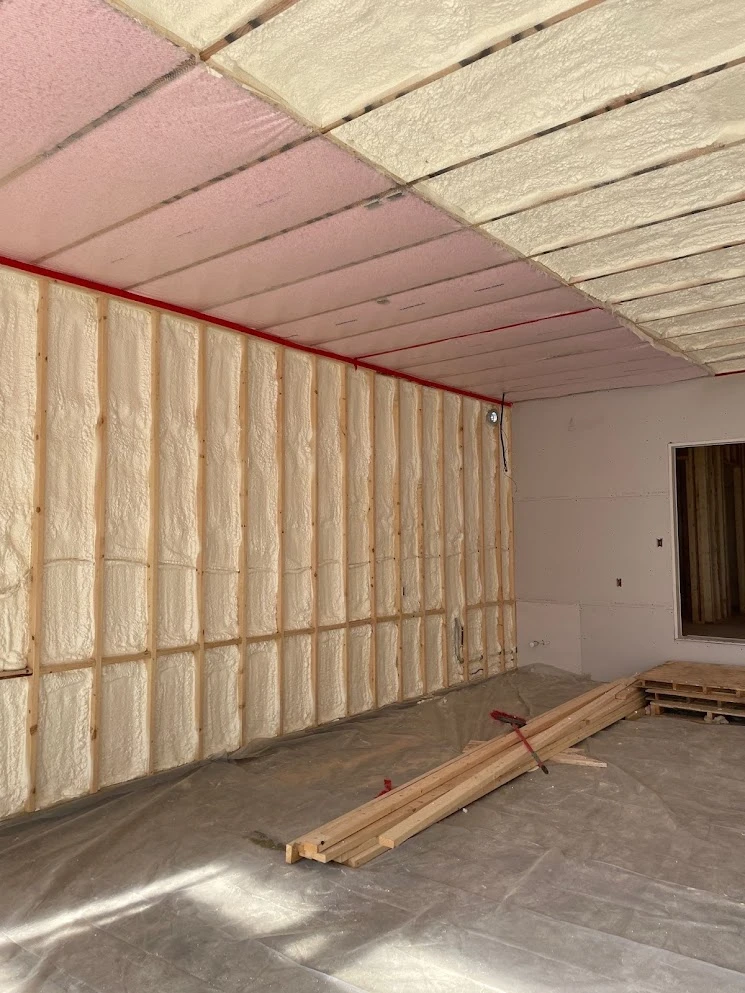
Homeowners in Otsego are educated buyers. They understand that a well-insulated home costs less to operate, feels more comfortable in every season, and holds its value better over time. Builders who specify spray foam insulation can point to several tangible advantages:
An Oak Ridge National Laboratory study presented at ASHRAE’s Buildings XI conference demonstrated that even basic spray foam air sealing in existing homes produced significant energy savings with payback periods as short as a few months. For new construction where spray foam is applied comprehensively, the long-term savings are even greater.
Not every area of a new home needs spray foam. Builders get the best return by targeting the locations where air leakage and thermal bridging are most severe:
| Project Type | Recommended Spray Foam Application | Key Consideration |
|---|---|---|
| New construction, 1,500-2,500 sq ft | Full cavity walls, rim joists, the crawl space | Meets code easily, maximizes energy savings |
| New construction, 2,500-4,000 sq ft | Rim joists, attic, select walls | Target critical air sealing locations |
| Retrofit existing homes | Rim joists, attic floor, crawl space | Focus on highest-leakage areas first |
| Pole barn or commercial | Roof deck, walls, foundation | Closed-cell for moisture resistance |
| Basement finishing | Rim joist critical seal, foundation walls | Condensation control in cold climate |
Choosing the right spray foam installer is as important as choosing the right material. Look for these indicators:
Peak Spray Foam Insulation helps builders and homeowners across Minnesota deliver higher-performing, more comfortable homes. Our team handles closed-cell spray foam, blown-in fiberglass, batt insulation, pole barn insulation, and commercial insulation projects with the attention to detail that Minnesota’s demanding climate requires. Whether you are framing a new subdivision in Otsego or retrofitting an existing home, we will assess your project, recommend the right approach, and install it to code.
Request a Free Quote | Schedule an Insulation Assessment
Call us at (612) 482-4742 or email [email protected] to discuss your next project. We are ready to show you what proper insulation can do for your home.
Yes. Minnesota’s Chapter 1322 specifically addresses spray-applied foam for foundation and crawl space walls, and spray foam meets or exceeds code R-value requirements with less thickness than fiberglass batts.
For builders in Climate Zone 6, spray foam provides air sealing, moisture control, and high R-value in one application. The reduced HVAC sizing, lower energy bills, and fewer warranty callbacks make it a practical investment.
Closed-cell spray foam is water-resistant and acts as a vapor retarder when applied at the correct thickness. It seals the crawlspace walls and rim joist against humid summer air and prevents condensation during cold winters.
Spray foam insulation does not settle, sag, or degrade over time. When installed correctly, it maintains its R-value and air-sealing properties for the life of the building, making it a permanent part of the home’s envelope.
Many builders use a hybrid strategy, applying spray foam at critical air sealing points like rim joists and using fiberglass batts or blown-in insulation in standard wall cavities. This approach balances performance and budget.