
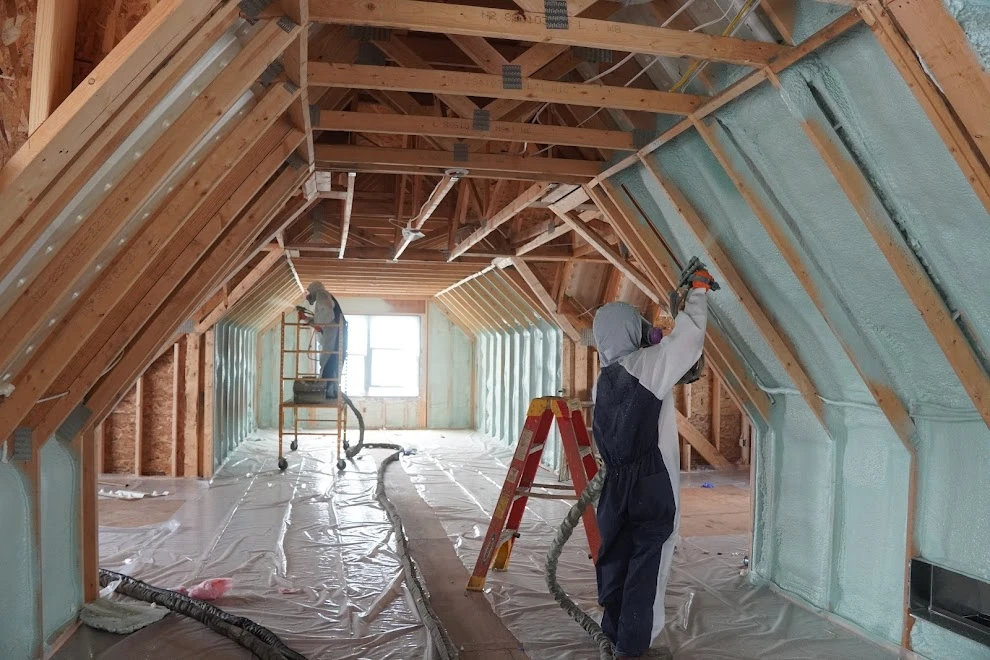
Builders in Annandale, MN are choosing spray foam insulation for new construction because it simultaneously addresses the three biggest performance demands of our harsh Minnesota climate: superior thermal resistance, an airtight seal, and built-in moisture control. Annandale sits in Wright County, which falls within IECC Climate Zone 6A, a heating-dominated region with winter design temperatures dropping to negative 9 degrees Fahrenheit. In that environment, traditional insulation materials alone often leave gaps that air and moisture can penetrate, driving up heating costs and risking condensation damage inside wall cavities. Spray foam expands on application to fill every crack, crevice, and penetration, creating a continuous thermal and air barrier that traditional batts and blown-in materials simply cannot match. The right choice ultimately depends on project goals and budget, but for builders focused on long-term energy performance, code compliance, and structural durability, spray foam delivers measurable advantages at every stage of a new build.
Minnesota winters are not forgiving, and Annandale is no exception. Wright County falls squarely within Climate Zone 6A, classified as cold and humid with a heating-dominated load profile. The winter 99% design temperature sits at negative 9 degrees Fahrenheit, while summer temperatures can still reach 89 degrees. That 98-degree temperature swing puts enormous stress on a building’s thermal envelope year-round.
The U.S. Department of Energy estimates that 56% of residential energy consumption goes toward heating and cooling. In a climate like ours, where the heating season stretches for roughly six to seven months, that percentage leans even heavier toward heating. When builders spec insulation that underperforms, homeowners feel it immediately in drafty rooms, uneven temperatures, and high utility bills. Spray foam insulation directly addresses this by delivering a higher R-value per inch than most alternatives and, more importantly, by sealing the air leaks that undermine even well-insulated assemblies.
The insulation R-value printed on a product label tells only part of the story. If a wall cavity is packed with fiberglass but the surrounding framing, electrical boxes, and plumbing penetrations are left unsealed, conditioned air escapes and outdoor air infiltrates. According to the Spray Polyurethane Foam Alliance, as much as 40% of a building’s energy is lost due to air infiltration alone. That is energy paid for but never actually used to heat or cool the living space.
Spray foam insulation closes that gap because it expands into and around every penetration during application. Common leak points that spray foam addresses include:
This dual function, insulating and air sealing in one step, is the primary reason builders select spray foam for new construction rather than pairing traditional batts with separate caulking, tape, and housewrap systems. The result is a tighter building with fewer drafts, more consistent indoor temperatures, and lower heating and cooling demands.
Minnesota’s residential energy code, found in Minnesota Rules Chapter 1322, sets specific minimum R-values for each building component based on climate zone. For Climate Zone 6, the current prescriptive requirements include:
| Building Component | Minimum R-Value (Zone 6) |
|---|---|
| Ceiling / Attic | R-49 |
| Wood Frame Wall | R-20 (or R-13 cavity plus R-5 continuous) |
| Floor Over Unconditioned Space | R-30 |
| Basement Wall | R-15 |
| Crawlspace Wall | R-15 |
These numbers represent the legal floor, not the performance ceiling. Builders who target code minimums often find that meeting the air leakage testing requirement of no more than 3 air changes per hour (ACH) is difficult without a dedicated air sealing strategy. Spray foam helps on both fronts: it delivers high R-values per inch and creates an airtight assembly that makes blower door testing more predictable.
Minnesota is also moving toward significantly stricter energy codes. Fresh Energy reports that state law now requires 70% less energy use in the 2038 Residential Energy Code compared to a 2006 baseline. Builders who invest in spray foam insulation today are positioning their projects to meet those upcoming standards without costly retrofits.
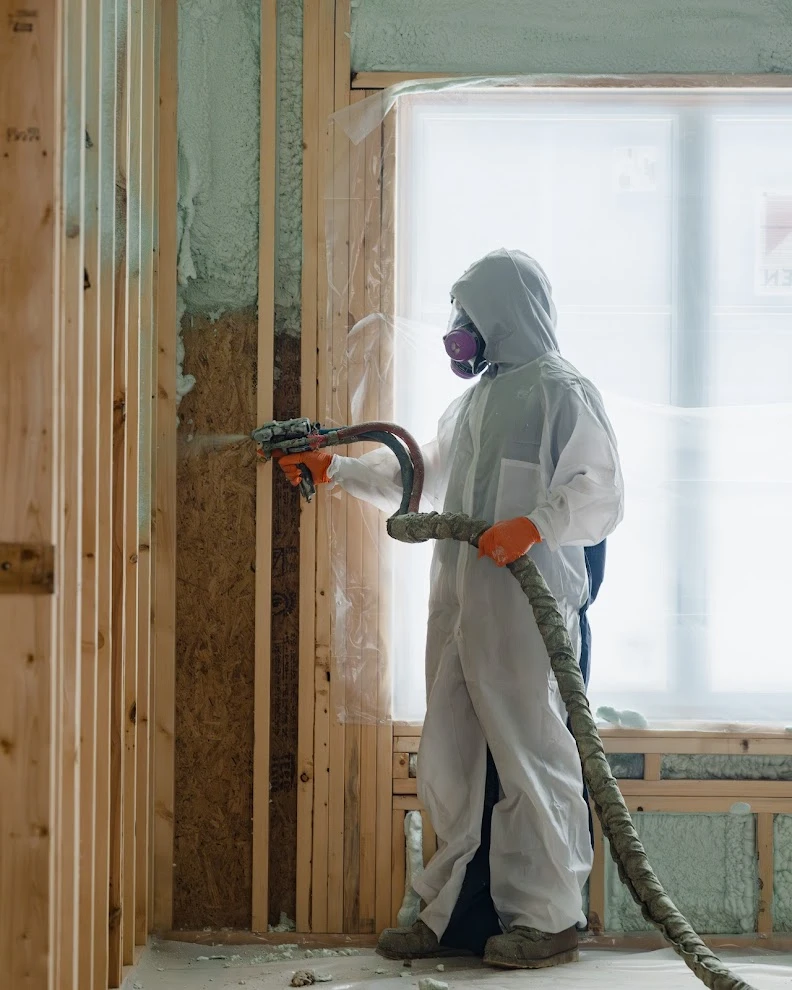
Cold climates create a persistent moisture challenge. Warm indoor air carries water vapor that migrates outward through wall and ceiling assemblies during winter. When that vapor reaches a cold surface below the dew point, it condenses, potentially leading to mold growth, wood rot, and degraded insulation performance.
Research published by Building Science Corporation demonstrates that closed-cell spray foam applied at thicknesses over 2 inches controls vapor diffusion to safe levels in climates up to 10,000 heating degree days, which covers all of Minnesota essentially. This means closed-cell spray foam can function as both the insulation layer and the vapor retarder in many wall assemblies, eliminating the need to install and detail a separate polyethylene sheet.
For basement and crawlspace walls, Minnesota code (1322.0402) includes specific provisions for spray-applied foam insulation. Closed-cell foam must meet the permeance requirements of not greater than 0.8 and must be sprayed directly onto the foundation wall with a minimum 1-inch gap between the foam surface and any interior framing. Open-cell foam in below-grade applications requires an additional vapor retarder and air barrier on the warm-in-winter side. This code recognition reflects the material’s proven ability to manage moisture in demanding conditions.
The EPA’s Energy Star program estimates that homeowners can save up to 20% on monthly energy bills by adding insulation and sealing air leaks. For new construction, where spray foam is installed from the start, those savings begin on day one rather than being retrofit costs.
Beyond monthly bills, spray foam influences the mechanical systems in a new home. Because the building envelope is tighter and better insulated, heating and cooling equipment can often be downsized. HVAC sizing can be reduced by as much as 35% without any loss of comfort or efficiency, according to the Spray Polyurethane Foam Alliance. A smaller HVAC system means lower equipment costs, reduced ductwork, and less energy consumption over the life of the home, which is one of the key benefits discussed in insulation types and benefits guide.
For builders, that translates into a competitive advantage. A home marketed with spray foam insulation, a smaller mechanical system, and verifiable energy performance stands out in the Annandale market, where buyers increasingly ask about energy savings, indoor air quality, and long-term operating costs.
| Feature | Spray Foam (Closed Cell) | Spray Foam (Open Cell) | Fiberglass Batts | Blown-In Fiberglass |
|---|---|---|---|---|
| R-Value Per Inch | R-6 to R-7 | R-3.6 to R-4 | R-2.9 to R-3.8 | R-2.2 to R-2.7 |
| Air Sealing | Excellent | Excellent | Minimal | Minimal |
| Vapor Retarder | Yes (2 inches plus) | Requires a separate layer | Requires a separate layer | Requires a separate layer |
| Moisture Resistance | High | Low | Low | Low |
| Sound Dampening | Good | Very Good | Moderate | Moderate |
| Best Application | Walls, basements, crawlspaces | Attics, sound walls | Standard cavities | Attics, existing walls |
Each insulation type has its place, but for new construction in a cold climate zone where air sealing, moisture control, and thermal performance all matter simultaneously, spray foam delivers the most complete package. Builders commonly specify closed-cell spray foam for walls, basements, and crawlspaces where moisture resistance and structural rigidity matter, while open-cell foam is often selected for attics and interior partitions where sound dampening and cost efficiency are priorities.
Choosing the right insulation contractor is just as important as choosing the right material. For builders planning new construction in Annandale, here are the indicators that separate a reliable partner from the rest:
At Peak Spray Foam Insulation, we help builders across the Annandale area spec and install insulation that meets Minnesota’s demanding code requirements while delivering the energy performance homeowners expect. Our team works with new construction projects ranging from 1,500 to 4,000-plus square feet, handling walls, attics, crawlspaces, basements, and commercial buildings. We bring deep familiarity with Wright County building standards and Climate Zone 6A conditions to every project.
Request a Quote | Schedule a Consultation
Contact us at [email protected] or call (612) 482-4742 to discuss your next project. We will walk through your plans, identify the best insulation strategy for each building component, and provide a clear, detailed proposal, so you can build with confidence.
Yes. Both closed-cell and open-cell spray foam are recognized under Minnesota Rules Chapter 1322 for residential and commercial new construction, with specific performance and installation standards for each application.
For closed-cell spray foam applied at 2 inches or thicker, research from Building Science Corporation shows the foam itself controls vapor diffusion to safe levels in Minnesota’s climate, eliminating the need for a separate polyethylene barrier in most wall assemblies.
Closed-cell spray foam achieves R-6 to R-7 per inch, significantly outperforming fiberglass batts at R-2.9 to R-3.8 per inch and blown-in fiberglass at R-2.2 to R-2.7 per inch. This higher per-inch performance allows builders to meet code R-values with less material thickness.
Yes. Because spray foam creates a much tighter building envelope, the Spray Polyurethane Foam Alliance notes that HVAC equipment sizing can often be reduced by up to 35% without sacrificing comfort or efficiency.
Minnesota law now requires a 70% reduction in residential energy use by the 2038 code cycle compared to a 2006 baseline. Builders who choose spray foam insulation today are building toward those stricter future standards from the start, avoiding costly upgrades later.