
Builders in St. Cloud, MN, work in one of the most demanding cold climates in the continental United States. Professional insulation is not optional for new construction here; it is the single most impactful decision you make for long-term energy performance, code compliance, and buyer satisfaction. St. Cloud sits in Stearns County, which falls under Minnesota Climate Zone 6, a classification that carries strict insulation R-value mandates for ceilings, walls, floors, basements, and crawl spaces. Whether you are building a single-family home, a multifamily development, or a commercial structure, the insulation strategy you choose during framing determines the building’s performance for decades. The right approach depends on your project type, budget, timeline, and the specific areas of the building envelope you need to protect. A comprehensive home insulation guide for Minnesota homeowners can help you select the most effective insulation strategy for long-term performance.
Minnesota’s energy code divides the state into two climate zones. Under Minnesota Rules Chapter 1323, Stearns County (where St. Cloud is located) is classified as Climate Zone 6, the southern zone. The northern tier of Minnesota counties fall into Climate Zone 7. This classification directly determines the insulation requirements for every new build.
St. Cloud experiences winter design temperatures of negative 20 degrees Fahrenheit, according to the outdoor design conditions table in the Minnesota Commercial Energy Code. Summer conditions reach 86 degrees dry bulb with 71 degrees wet bulb. That 100+ degree temperature swing over the course of a year puts extraordinary stress on a building’s thermal envelope. The insulation in your walls, attic, basement, and crawl space is what stands between the conditioned living space and those extremes.
According to Minnesota Rules Chapter 1322, residential buildings in Climate Zone 6 must meet these minimum prescriptive R-values:
| Building Component | Minimum R-Value Requirement |
|---|---|
| Ceiling / Attic | R-49 |
| Wood Frame Wall | R-20 cavity + R-5 continuous insulation, or R-13 + R-10 continuous, or R-0 + R-20 continuous |
| Floor Over Unconditioned Space | R-30 |
| Basement Wall | R-15 |
| Crawl Space Wall | R-15 |
| Mass Wall | R-15/20 |
These are minimums. Building to code means meeting the legal floor, not delivering peak performance. The Insulation Institute points out that a building constructed only to code is meeting the legal minimum, not providing additional value to the homeowner.
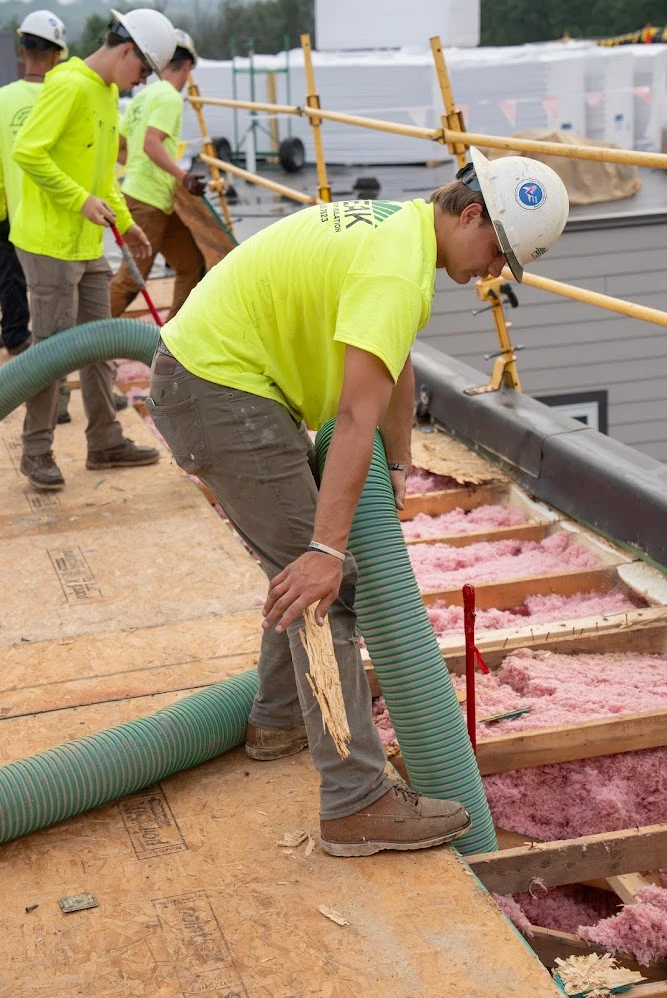
The U.S. Department of Energy explicitly states that adding insulation during construction is more cost-effective than retrofitting after the house is finished. This is something every St. Cloud builder should take to heart. During the framing stage, every cavity is open and accessible. A professional insulation crew can spray, blow, or place insulation into wall bays, ceiling joists, rim joists, and floor assemblies without removing drywall, siding, or finishes. Understanding different insulation types and benefits helps builders choose the right materials before construction is complete.
Retrofit insulation in an existing home requires cutting holes, working in confined spaces, and dealing with obstacles like wiring, plumbing, and HVAC runs that were installed after framing. The labor intensity alone makes retrofit projects more disruptive and far more expensive per square foot. For builders, this means the insulation decision during new construction is a one-time opportunity to get the building envelope right from the start.
Beyond access, new construction allows the builder to coordinate insulation with air sealing, moisture control, and HVAC rough-in simultaneously. The DOE recommends a whole-house systems design approach where insulation interacts properly with other building components for maximum efficiency.
Some builders consider handling insulation in-house to save on subcontractor costs. The risks of this approach are substantial, especially in Climate Zone 6, where code compliance is tightly enforced and performance expectations are high.
Professional insulation contractors bring several advantages that general framing crews typically lack:
A poorly insulated wall cavity might look fine behind drywall, but it will fail blower door testing, fail inspection, or worse, create hidden moisture problems that surface years after the warranty expires.
Builders in St. Cloud need to pay attention to where Minnesota’s energy code is heading. According to Fresh Energy, Minnesota has enacted legislation requiring new residential construction to achieve near-zero energy use by 2038, with a mandated 70% reduction in energy use compared to a 2006 baseline. Commercial buildings face an 80% reduction by 2036.
This means the code requirements you follow today are the floor, not the ceiling. Energy code updates now happen every three years instead of six. Builders who invest in quality insulation and air sealing now will be ahead of the curve as requirements tighten. Those who build to the bare minimum today will face increasingly difficult and expensive upgrades to meet future standards. Working with trusted insulation services in St. Cloud, MN, can help ensure your project exceeds current requirements and remains efficient for years to come.
For builders pursuing Energy Star or Passive House certifications, exceeding current code is already a requirement. Even if you are not targeting those programs, buyers in the St. Cloud market are becoming more energy-conscious, and a well-insulated home is a marketable advantage.
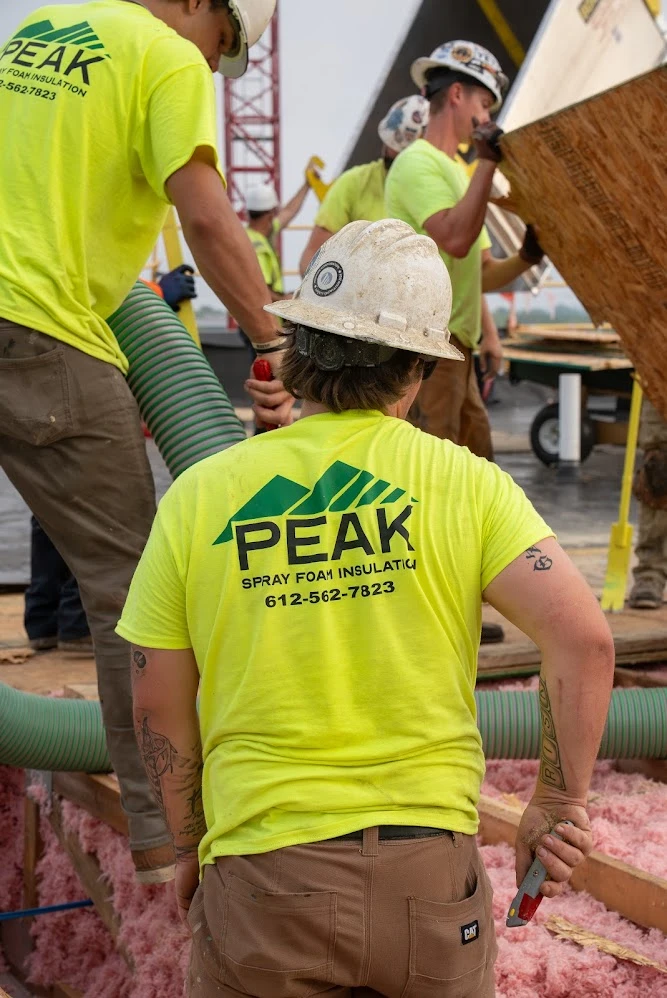
Not all insulation performs equally in a cold climate. The right choice depends on the building component, the project budget, and the performance targets you need to hit.
| Insulation Type | R-Value Per Inch | Best Application | Key Advantage |
|---|---|---|---|
| Closed Cell Spray Foam | R-6.0 to R-7.5 | Basement walls, crawl spaces, rim joists | Air barrier and vapor retarder in one step |
| Open Cell Spray Foam | R-3.5 to R-3.8 | Wall cavities, attics | Fills gaps completely, good sound dampening |
| Blown-In Fiberglass | R-2.2 to R-4.3 | Attics, existing wall cavities | Cost-effective for large open areas |
| Batt Insulation (Fiberglass) | R-2.9 to R-3.8 | Standard wall cavities, floors | Familiar, widely available |
| Rigid Foam Board | R-3.8 to R-6.5 | Exterior continuous insulation | Eliminates thermal bridging at studs |
In Climate Zone 6, closed cell spray foam is particularly valuable for below-grade applications like basement walls and crawl spaces. Minnesota’s energy code includes detailed requirements for spray-applied interior foam insulation, including permeance ratings and gap requirements between foam and framing. Professional installers are familiar with these specifications and ensure compliance.
Single-family home builders: Your buyers are comparing heating bills with neighbors. Proper insulation, especially in the attic and walls, directly affects monthly utility costs and comfort complaints after move-in. A well-insulated home reduces callback requests related to cold rooms, drafty windows, and high energy bills.
Multifamily developers: Sound transmission between units is a major complaint in apartment buildings. Insulation in shared walls and floor-ceiling assemblies addresses both thermal and acoustic performance. Professional installation ensures consistent coverage across dozens or hundreds of units.
Commercial builders: The 2024 Minnesota Commercial Energy Code requires compliance with ASHRAE 90.1-2019 for all commercial structures. Building envelope requirements for Climate Zone 6 include R-23 continuous insulation on roofs, R-13 minimum for metal building walls, and R-30 for attics. Commercial projects also face air leakage testing requirements and mandatory air barrier continuity.
Pole barn and accessory structure builders: Agricultural and outbuilding construction in Stearns County benefits from spray foam insulation at the roofline and in walls to prevent condensation, a common issue in metal buildings during cold weather.
Choosing an insulation contractor for your St. Cloud build comes down to a few practical indicators. A strong partner will communicate clearly about R-value targets for each building component before the job starts. They will show up when scheduled and coordinate with your framing crew to avoid delays. They will understand Minnesota’s specific energy code requirements for Climate Zone 6 and be able to explain how their work meets those standards. They will provide proper documentation for code inspection, including insulation certificates and any required blower door test results. They will also stand behind their work if issues arise during the inspection process.
A professional crew treats your job site with respect, protects finished surfaces, and cleans up after application. They will also advise you on vapor barrier placement, air sealing priorities, and coordination with mechanical rough-ins rather than just showing up and spraying material.
At Peak Spray Foam Insulation, we work with builders across St. Cloud, MN, and the surrounding area to deliver code-compliant, high-performance insulation for new construction projects. Our team understands the demands of Minnesota’s Climate Zone 6 and the specific requirements of the Minnesota Residential and Commercial Energy Codes. We install closed-cell spray foam, blown-in fiberglass, batt insulation, and commercial insulation tailored to your project’s needs. Reach out to us at [email protected] or call (612) 482-4742 to discuss your next build. We are ready to help you meet code, exceed buyer expectations, and build structures that perform for decades.
Request a Free Quote | Schedule a New Build Consultation
St. Cloud falls in Climate Zone 6 under Minnesota’s energy code. Residential new builds require a minimum R-49 for ceilings, R-20+5ci for wood frame walls, and R-15 for basement walls, as specified in Minnesota Rules Chapter 1322.
While possible, self-installation carries a significant risk in Minnesota’s climate. Improper coverage, compression, missing air seals, and incorrect vapor barrier placement can lead to failed inspections, moisture damage, and code violations that are far more expensive to fix later.
Spray foam provides both insulation and air sealing in a single application, delivers a higher R-value per inch than fiberglass, and acts as a vapor retarder when using closed-cell. For basement walls and crawl spaces in Climate Zone 6, these benefits make spray foam a strong choice.
Commercial builds must comply with the 2024 Minnesota Commercial Energy Code based on ASHRAE 90.1-2019, effective January 5, 2024. Requirements include specific R-values for roofs, walls, and floors, plus mandatory air barrier systems and air leakage testing.
Building inspectors in St. Cloud enforce the Minnesota State Building Code uniformly. Insulation that fails to meet R-value requirements, has gaps or compression, or lacks proper air sealing and vapor barriers will not pass inspection, requiring correction before a certificate of occupancy can be issued.