
That sunken section of your driveway you step over every morning, the sidewalk slab that shifted last spring, the warehouse floor that’s developed a noticeable dip over the years. These are not just cosmetic annoyances. Uneven concrete is a real problem that worsens over time, and ignoring it can lead to expensive repairs, safety hazards, and even legal liability. Concrete lifting offers a way to address all of these issues without the disruption and cost of tearing out and replacing the slab entirely. Many property owners choose professional concrete lifting services to restore safety, stability, and appearance without full slab replacement.
We have spent years working with concrete surfaces on residential and commercial properties, and we have seen firsthand how soil movement silently undermines even the strongest slabs. This guide draws on that field experience to give you a thorough understanding of how concrete lifting works, why concrete settles in the first place, which method is right for your situation, and what to expect from start to finish.
Concrete seems indestructible, but it is only as strong as the ground beneath it. Understanding why slabs sink requires looking at the soil, not the concrete itself. InterNACHI’s guide to soils and settlement explains that soil is a mixture of minerals, water, air, and organic matter. The exact balance of those ingredients varies by location, and that variation directly affects how concrete performs over time.
Soil comes in a few basic types, and each behaves differently under the weight of a concrete slab:
Soil does not always sit still. Three main processes cause concrete to sink or shift:
1. Soil Erosion and Washout
Water is the single biggest enemy of stable concrete. Poor drainage, leaking pipes, or heavy rainfall can wash soil particles out from beneath a slab. As Wikipedia’s concrete leveling entry notes, soil erosion is especially common at locations with improper drainage, where water gradually removes the supporting material and creates voids. The concrete remains intact for a while, but with nothing supporting it from below, it eventually cracks and sinks into the space.
2. Poor Soil Compaction
When a concrete slab is poured, the soil underneath must be properly compacted. The excavation process naturally loosens soil, creating larger spaces between particles. If this soil is not mechanically compacted before the slab is placed, it will continue to compress over time under the weight of the concrete. InterNACHI describes this as “secondary consolidation,” a long-term process in which the weight of the structure slowly forces water out of the spaces between soil particles, causing the ground to settle. This happens gradually, which is why a newly poured slab can look perfect for years before suddenly showing signs of unevenness.
3. Expansive Soil Movement
In areas with clay-heavy soil, the swell-shrink cycle is relentless. During wet seasons, clay absorbs water and expands, sometimes exerting enough upward pressure to lift a slab. During dry periods, the clay shrinks and pulls away from the bottom of the concrete. This back-and-forth movement weakens the slab over time, causes cracking, and creates uneven surfaces. Foundation Recovery Systems notes that exposure to the sun, dry climates, and even nearby vegetation absorbing moisture from the ground all contribute to this cycle.
Beyond soil behavior, a few other things accelerate concrete settlement:
Key Takeaways:
Concrete lifting, sometimes called slab jacking or concrete leveling, is the process of raising a sunken slab back to its original position by injecting material beneath it. InterNACHI’s mudjacking overview explains that this approach has been used since the early 20th century, when contractors first started using hydraulic pressure to lift large concrete slabs.
Today, three primary methods dominate the field. Each has distinct advantages and limitations.
Mudjacking is the oldest and most traditional approach. The process involves drilling holes into the sunken concrete and pumping a slurry mixture beneath the slab. That slurry is typically made from a blend of sand, soil, cement, and water, though exact compositions vary by contractor and application. Understanding the benefits of concrete lifting can help property owners compare mudjacking with newer repair methods.
According to Wikipedia, mudjacking typically requires holes between 1 and 2 inches in diameter. The slurry fills voids beneath the slab, and as pressure builds, it forces the concrete upward. Once the slab reaches the desired level, the holes are patched with color-matching grout.
Advantages of mudjacking:
Limitations of mudjacking:
This method uses pulverized limestone (agricultural lime) mixed with water, and sometimes Portland cement, to create a slurry of the consistency of a thick milkshake. It is pumped through 1-inch holes under hydraulic pressure.
The low injection pressure gives technicians fine control over the lifting process, which reduces the risk of cracking the slab. Once cured, the limestone grout creates a hard, stone-like base beneath the concrete. Wikipedia notes that stone slurry grout can achieve compressive strengths of 240 pounds per square inch, and with added cement, that figure can exceed 6,000 psi.
Advantages of limestone grout leveling:
Limitations of limestone grout leveling:
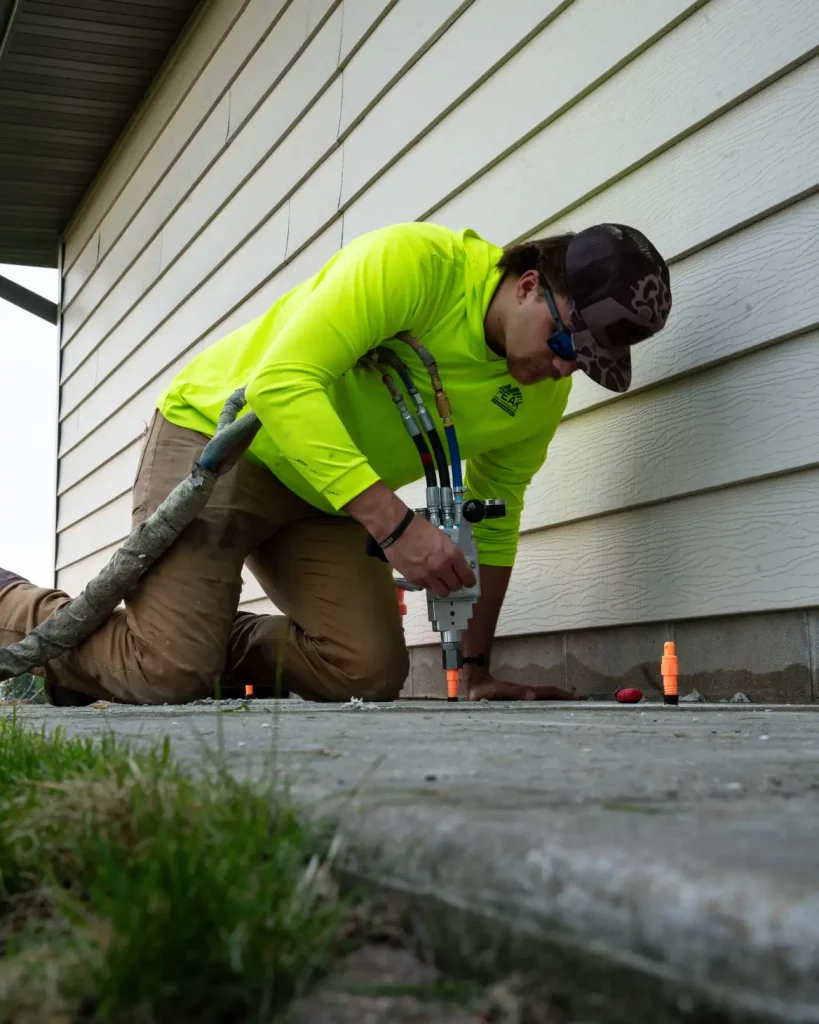
Polyurethane foam injection is the most modern approach and has become the preferred method for many applications. A two-part polymer is injected through holes smaller than an inch in diameter. As the liquid resin reacts, it expands into a high-density structural foam that fills voids and lifts the slab.
The foam itself weighs only 2 to 4 pounds per cubic foot, which is a dramatic difference from the 100 pounds per cubic foot of cement-based slurry. This lightweight property means polyurethane adds virtually no additional load to the soil, reducing the risk of further settlement. The foam is also waterproof and hydrophobic once cured, so it will not erode or retain moisture.
According to Slabjack Geotechnical’s guide, polyurethane foam hardens within 15 minutes and provides immediate compressive strength. Some formulations achieve compressive strengths of 50 to 100 psi in a free-rise state, translating to 7,200 to 14,000 pounds of support per square foot.
Advantages of polyurethane foam injection:
Limitations of polyurethane foam injection:
| Feature | Mudjacking | Limestone Grout | Polyurethane Foam |
|---|---|---|---|
| Hole Size | 1-2 inches | ~1 inch | Less than 1 inch |
| Material Weight | ~100 lbs/cu ft | ~100 lbs/cu ft | 2-4 lbs/cu ft |
| Cure Time | 24+ hours | Several hours | 15-30 minutes |
| Water Resistance | Poor to moderate | Moderate (varies by mix) | Excellent (hydrophobic) |
| Void Filling | Good | Very good | Excellent |
| Lifespan | 5-10 years | 10-20 years | 20+ years |
| Equipment Reach | Long distance | Within 100 feet of the truck | Mobile, flexible |
| Soil Load Added | Significant | Significant | Minimal |
| Cleanup Required | Moderate to high | Moderate | Low |
Expert Tip: If your property has expansive clay soil, polyurethane foam is generally the safest choice. Its lightweight nature means you are not adding hundreds of pounds of heavy slurry on top of soil that already has a tendency to shift with moisture changes. The waterproof property also prevents the foam from breaking down during the next wet season.
Polyurethane foam injection has become the most requested method we work with, and for good reason. Here is exactly what happens during a typical residential or commercial project.
Before any equipment arrives, a thorough assessment is essential. We inspect the affected area for visible cracks, gaps between the slab and adjacent structures, and signs of ongoing soil movement. This evaluation determines whether lifting is even feasible. Concrete that is severely cracked, crumbling, or structurally failed may need replacement instead.
We also look for the root cause of the settlement. If a gutter downspout is channeling water directly onto a slab edge, or a plumbing leak is washing away soil, those issues must be resolved before lifting. Fixing the symptom without addressing the cause will only lead to repeated settlement.
The work area is cleared of obstacles, furniture, vehicles, and landscaping features that could interfere with access. We mark underground utilities and flag any areas of concern. The concrete surface is cleaned so that drill holes can be placed precisely and the lifting process can be monitored accurately.
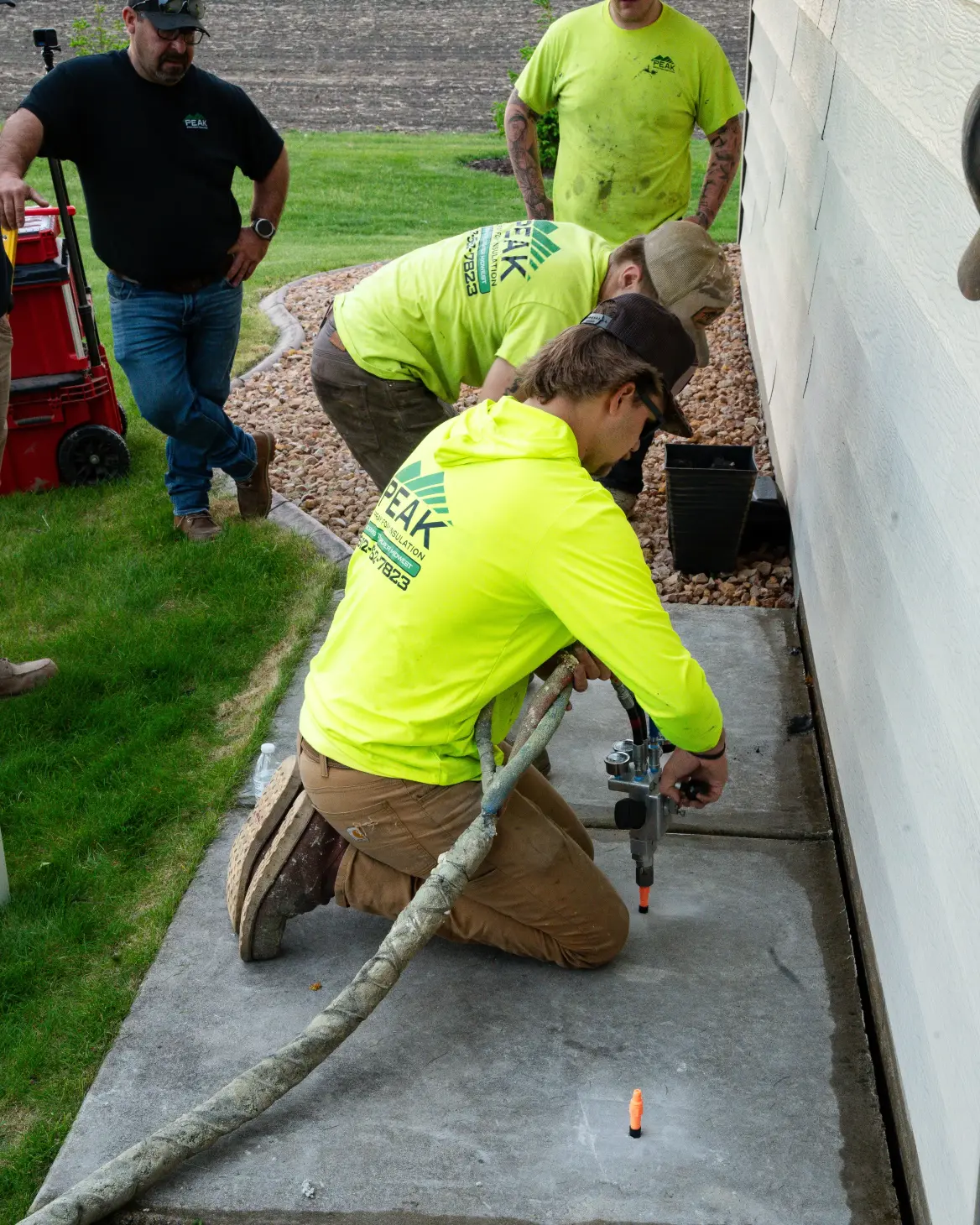
Small holes, typically about the size of a dime (5/8 inch), are drilled through the concrete slab at strategically planned intervals. The placement of these holes depends on the size and shape of the sunken area, the thickness of the slab, and the lift distance required. Fewer and smaller holes are one of the main advantages of polyurethane over mudjacking.
Injection ports are inserted into the drilled holes. Using specialized equipment, the two-part polyurethane resin is injected beneath the slab. The foam expands rapidly, typically within 10 to 15 seconds, filling voids and compacting loose soil as it spreads.
The lifting process is monitored carefully. Technicians watch the slab’s movement with each injection cycle, adjusting volume and placement to achieve even, controlled lifting. The goal is to bring the slab back to level without over-raising it.
Expert Tip: A good technician will lift incrementally rather than trying to raise the entire slab in one pass. Small, controlled injections allow the foam to expand and distribute evenly, resulting in a smoother, more accurate lift. Rushing the process increases the risk of over-raising or cracking.
Once the desired level is achieved and the foam has fully cured, the injection ports are removed. The drill holes are patched with a non-shrink grout that is color-matched to the existing concrete. In most cases, the patches are barely noticeable once cured.
The completed surface is inspected for level, and any adjacent joints or cracks are evaluated. We check that drainage patterns are intact and that no new issues have been introduced during the lifting process. The surface is ready for immediate use in most applications.
Key Takeaways:
One of the most common questions we hear is whether lifting is even an option or if the concrete needs to be torn out and poured fresh. There is no universal answer, but we can evaluate several factors to make the right call.
Expert Tip: If you are unsure, start with a professional assessment. Most reputable concrete lifting companies will evaluate your situation and tell you honestly whether lifting is viable. If replacement is the better option, they will say so upfront rather than wasting your time and money on a repair that will not hold.
Uneven concrete is not just an eyesore. It is a safety hazard that can carry serious legal and financial consequences for property owners.
When concrete surfaces develop a vertical change of more than a quarter inch, they cross the line from a minor imperfection into legitimate trip hazard territory. That small differential might not look like much, but it is enough to catch a shoe, send a pedestrian off balance, and cause a fall that results in serious injury.
For commercial property owners, the stakes are even higher. Customers, employees, and visitors who trip on uneven concrete can file liability claims against the business. These claims can include medical expenses, lost wages, and pain and suffering damages. For commercial property managers, maintaining level concrete surfaces is a basic part of risk management.
The U.S. Access Board’s ADA Standards set specific requirements for accessible walking surfaces. Under these standards, changes in level on accessible routes are limited to a maximum of one-quarter inch without any beveling treatment. If the vertical change is between one-quarter inch and one-half inch, it must have a beveled edge with a slope no steeper than 1:2. Changes in level above one-half inch must be treated as a ramp.
For businesses open to the public, these are not suggestions. Non-compliant sidewalks, walkways, and building entrances can result in ADA complaints, lawsuits, and mandatory remediation. Concrete lifting is often the most practical way to bring surfaces back into compliance without the disruption of full replacement.
Property insurance policies generally require owners to maintain safe conditions. A documented history of trip hazards, combined with evidence that the owner knew about the problem and did nothing to fix it, can weaken an insurance defense in a liability claim. Having concrete lifted promptly after settlement is noticed is both a safety measure and a prudent legal strategy.
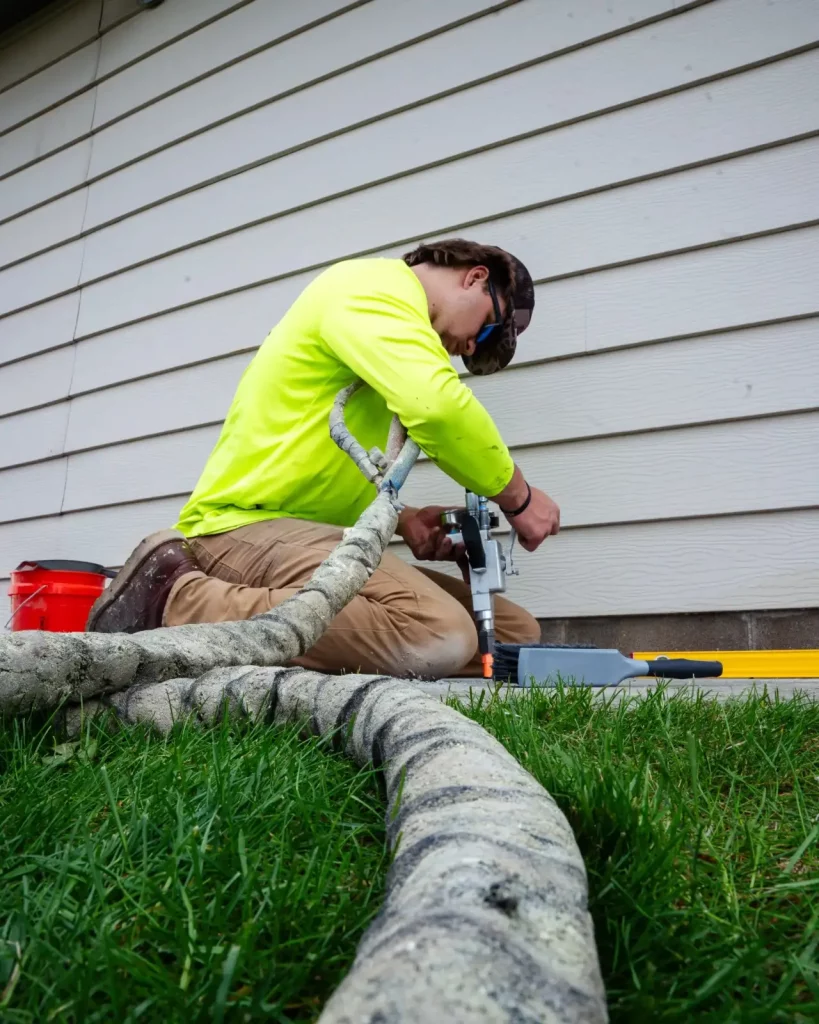
While the fundamental process is the same, residential and commercial projects differ in scope, complexity, and the factors that drive decision-making.
On homes, concrete lifting is most commonly needed for:
Residential projects tend to be straightforward and can often be completed in a single day. The homeowner’s primary concerns are usually safety, aesthetics, and preventing further damage to the slab.
Commercial projects are typically larger and more complex. Common applications include:
Commercial projects often require more extensive site assessment, coordination with building management, and work scheduled outside of business hours to minimize disruption. The cost of doing nothing on a commercial property is also higher, given the exposure to liability claims, regulatory fines, and operational disruptions.
Concrete lifting solves the immediate problem, but keeping the slab level over the long term requires some attention to the surrounding conditions. Here are practical steps property owners can take to extend the life of a lifted surface.
Water is the primary cause of concrete settlement, so managing it around your repaired slab is essential. Make sure gutters and downspouts direct water away from concrete edges. Fix any plumbing leaks promptly, even small ones. Grade the soil around slabs so water flows away rather than pooling against the concrete.
The joints between concrete panels are designed to allow for slight movement, but they need to be sealed to prevent water infiltration. Use a high-quality polyurethane or silicone-based joint sealer and reapply it every few years as it wears. Cracks in the concrete surface should also be sealed promptly to prevent moisture from reaching the soil below.
Tree roots and large shrubs growing near concrete can extract significant moisture from the soil, accelerating shrinkage in clay-rich areas. In extreme cases, roots can physically push slabs upward. Plant trees and large bushes at a safe distance from concrete surfaces, or use root barriers if existing landscaping is too close.
Walk your property periodically and look for new settling, cracking, or gaps between slabs. Catching problems early allows for small corrective lifts before the situation worsens. Annual inspections are a reasonable schedule for most properties, and more frequent checks are recommended after extreme weather events like flooding or prolonged drought.
Expert Tip: After a concrete lifting project, pay close attention to the repaired area during the first few heavy rainfalls. If you notice water pooling in spots that previously drained well, or if the slab shows any signs of shifting, contact your contractor right away. Early intervention on a small issue is far less expensive than waiting until the slab settles again.
Most residential projects are completed in a few hours. Commercial or multi-slab projects may take one to two days, depending on the scope. Polyurethane foam cures within 15 to 30 minutes, so surfaces are usable almost immediately after the work is done.
No. Concrete that is severely cracked, crumbling, or structurally compromised may need replacement. Concrete that has been pushed upward by expansive soil also cannot be corrected through lifting. A professional assessment will determine whether your slab is a good candidate.
Polyurethane foam lifting typically lasts 20 years or more when the underlying cause of settlement has been addressed. Mudjacking repairs generally last 5 to 10 years. Lifespan depends heavily on soil conditions, water management, and whether the original cause of settlement has been corrected.
The patched holes are small and color-matched to your concrete. With polyurethane injection, holes are about the size of a dime. Over time, weathering blends the patches further. Most people do not notice them after a few weeks.
Compared to concrete replacement, lifting is relatively clean. Polyurethane foam injection requires minimal cleanup since the foam expands and hardens in place beneath the slab. Mudjacking produces more mess from the slurry material. Either way, the work area is cleaned and restored before the crew leaves.
Yes, polyurethane foam injection can be performed in cold temperatures because the chemical reaction generates its own heat during curing. Mudjacking with water-based slurry is more temperature-sensitive and may not be effective in freezing conditions. If you live in a cold climate, foam lifting is generally the better choice for winter or early spring projects.
Uneven concrete is a problem that does not fix itself. Every season that passes, the settlement typically worsens. Cracks spread. Trip hazards grow. Liability exposure increases. The good news is that modern concrete lifting technology, particularly polyurethane foam injection, makes it possible to restore level, safe surfaces in hours rather than days, with minimal disruption to your property or business operations.
The steps are straightforward. Identify the problem areas on your property. Determine the likely cause of settlement. Have a professional assess whether lifting is the right solution. Address any underlying drainage or soil issues. Then schedule the repair before the damage gets worse and costs climb higher.
If you found this guide helpful, bookmark it and use it as a reference whenever concrete questions come up. The more you understand about why your concrete behaves the way it does, the better decisions you will make about maintaining it.
If you have concrete surfaces that have settled, cracked, or shifted on your residential or commercial property, our team at Peak Spray Foam Insulation is here to help. We can assess the situation, explain your options, and recommend the best approach for your specific needs. Reach out to us at [email protected] or call us directly at (612) 482-4742 to discuss your project. We are happy to answer your questions and help you get your concrete back to level.