
If your driveway, patio, sidewalk, or garage floor has started to feel uneven, show cracks, or collect water where it never used to, you are likely looking at the early stages of concrete settlement. In Annandale, MN, where freeze-thaw cycles and glacial soils are a constant reality, these signs tend to appear faster than homeowners expect. Acting on the earliest warning signs usually allows you to avoid full slab replacement and restore safety and function with concrete lifting methods like foam injection or mudjacking. The right approach depends on how much the slab has settled, the condition of the concrete itself, and what caused the underlying soil to shift. Below, we break down every visible, structural, and seasonal signal that tells you it is time to call a professional and explore concrete lifting solutions.
Understanding the root cause helps you recognize whether what you are seeing is normal aging or active settlement that needs immediate attention.
The most common cause is an inconsistency of moisture in the soil beneath the slab. According to Wikipedia’s concrete leveling entry, soil expands and contracts as moisture levels fluctuate during dry and rainy seasons, and naturally occurring soils across the upper Midwest can consolidate over time. Soil erosion from improper drainage compounds the problem by washing away the supporting material underneath.
In cold climates, the freeze-thaw cycle is a major cause of concrete damage. Water fills the voids within and beneath concrete, freezes, and expands roughly 9 percent in volume. This exerts pressure on the surrounding material, and when that pressure exceeds the tensile strength of the concrete, cracks form. Each subsequent freeze-thaw cycle enlarges those voids, enabling more water infiltration and more cracking in a progressively destructive loop.
The University of Wisconsin Cooperative Extension identifies several additional contributors: poorly compacted subgrade, expansive soils that shrink and swell with moisture changes, hard and soft spots that create non-uniform support, and frost heaving that can cause cracks and serious structural damage to concrete floors. All of these conditions are common in Annandale, where soils formed in glacial till and outwash plains create variable bearing capacity across even a single property.
Small cracks that form where your driveway meets the garage, along patio edges, or within existing control joints are typically the first visible sign. As the underlying soil drops, the concrete flexes and develops stress fractures. These cracks may look minor, but they are a reliable indicator that voids are forming beneath the surface. Addressing these issues early with concrete lifting in Annandale, MN can help prevent further settlement and damage.
When one section of a slab sits lower than an adjacent section, you have a trip hazard and a liability concern. Even a half-inch differential across a walkway is enough to cause someone to stumble. Measuring the gap with a straightedge or level helps you determine whether the movement is active or stable.
If rainwater or snowmelt collects in depressions on your driveway, patio, or garage floor, the slab has shifted. Pooling water then seeps into cracks and beneath the slab, accelerating the exact soil erosion that caused the problem in the first place. This is a compounding issue that gets worse with each storm.
When a driveway slab pulls away from the garage foundation, or a patio separates from the house, you are looking at differential settlement. The gap may start narrow but will widen as soil continues to shift. These gaps also allow water and pests direct access to your foundation.
If interior doors near your garage or patio suddenly drag, or windows become difficult to open, a settling exterior slab may be pulling on the surrounding framing. This sign is easy to dismiss as a humidity issue, but when it appears alongside other symptoms, settlement is the likely culprit.
Surface flaking, known as spalling, occurs when the top layer of concrete fractures and falls away. While spalling can result from freeze-thaw damage alone, it often accompanies settlement because the shifting slab creates micro-fractures that allow water to penetrate deeper into the concrete matrix.
If you hear a hollow or drum-like sound when stepping on certain areas of your driveway or patio, there may be a void beneath the concrete where soil has washed away or compacted. This is a serious sign that the slab is no longer supported and could crack under vehicle or foot traffic.
| Sign Observed | Severity Level | Urgency | Recommended Action |
|---|---|---|---|
| Hairline cracks in control joints | Low | Monitor quarterly | Document with photos, track growth |
| Water pooling after rain | Low to Moderate | Schedule assessment | Check drainage, evaluate slab level |
| Gaps between slab and foundation | Moderate | Assess within 1 to 2 months | Measure gap width, monitor changes |
| Uneven surface with trip hazard | Moderate to High | Professional evaluation | Get a leveling quote before it worsens |
| Sticking doors or windows | High | Prompt assessment | Check if settlement is the cause |
| Spalling or surface flaking | High | Professional evaluation | May indicate advanced freeze-thaw damage |
| Hollow sound underfoot | High | Immediate assessment | Voids beneath slab need filling |
`The Minnesota DNR tracks frost depth across the state, and the data tells a clear story. Median frost depths at monitoring stations have reached 20 inches or more in a typical winter, with some years exceeding 35 inches. Annandale sits in Wright County, where MnDOT maintains frost and thaw monitoring sensors that confirm repeated freeze-thaw cycling throughout the cold season.
Each time the ground freezes and thaws, the soil beneath your concrete slabs expands and contracts. Poorly compacted backfill around foundations and under driveways is especially vulnerable. The Federal Highway Administration’s research confirms that freeze-thaw damage is progressive, meaning it increases in severity with each cycle if not addressed. In a state that experiences dozens of freeze-thaw events per winter, even a single season without intervention can move a slab from slightly uneven to visibly sunken.
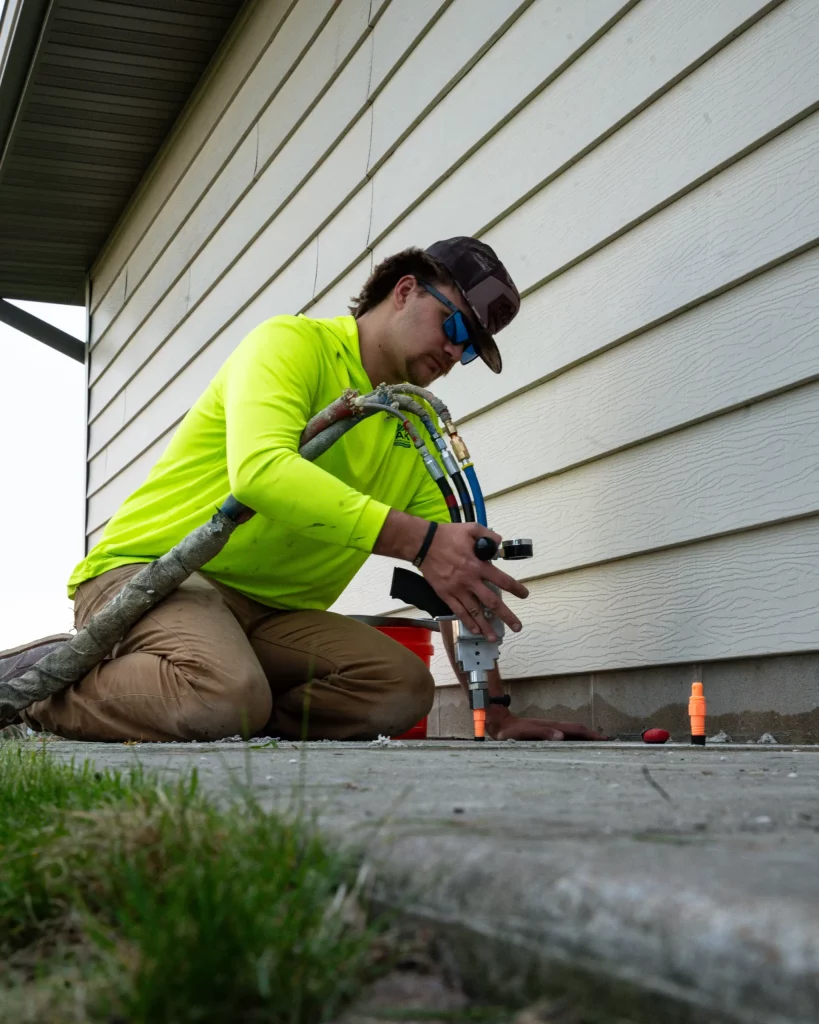
When you decide to address settling concrete, understanding your options helps you have an informed conversation with any contractor you hire.
| Method | How It Works | Hole Size | Cure Time | Best For |
|---|---|---|---|---|
| Mudjacking (Slabjacking) | Cement/soil slurry pumped under slab via hydraulic pressure | 1 to 2 inches | 24 to 48 hours | Budget-friendly repairs, large areas |
| Stone Slurry Grout Leveling | Pulverized limestone slurry fills voids and lifts slab | About 1 inch | 24 to 48 hours | Precise control, high compressive strength |
| Polyurethane Foam Injection | Two-part polymer expands to fill voids and lift slab | Less than 1 inch | 15 to 30 minutes | Fast turnaround, water-resistant, minimal cleanup |
Each method works by drilling strategic access holes, filling under-slab voids, and lifting the concrete back toward its original position. The concrete leveling process is rapid compared to full removal and replacement, minimally disturbs surrounding landscaping, and keeps concrete waste out of landfills. Polyurethane foam offers the fastest cure time and is hydrophobic once cured, meaning it will not absorb water or erode. Mudjacking and stone slurry methods offer high compressive strength at a lower material cost but require larger access holes and more cleanup.
Not every contractor approaches concrete lifting the same way. Here is what separates a qualified professional from an unreliable one:
Start by documenting what you see. Take photos, note when you first noticed the issue, and measure any visible differentials with a level. Then contact a professional for an on-site evaluation. Even if the settlement appears minor, an expert assessment gives you a baseline to monitor and prevents small problems from becoming expensive replacements.
Peak Spray Foam Insulation serves homeowners in Annandale, MN, and the surrounding communities with professional concrete lifting and leveling services designed to restore safety and function to your settled slabs. Our team evaluates every project on-site, identifies the underlying cause of settlement, and recommends the most effective lifting method for your specific situation. Reach out to us at (612) 482-4742 or [email protected] to discuss your concrete concerns.
Request a Quote | Schedule Your On-Site Assessment
Most concrete lifting projects are completed in a single day, and the slab is usable within hours. Full replacement typically takes several days of demolition, grading, pouring, and curing before the surface can bear any traffic.
Concrete that is structurally intact with moderate cracking usually responds well to lifting. Severely fragmented slabs, crumbling, or deeply cracked may not hold together during the lift process and may require replacement instead.
Lifting addresses the void and stabilizes the slab, but if the original cause (poor drainage, erosion, expansive soil) is not corrected, settlement can recur. A qualified professional will evaluate drainage and soil conditions as part of the assessment.
Yes, when properly installed by trained technicians, polyurethane foam is a widely used, structurally rated material for residential concrete leveling. It cures quickly, does not retain moisture, and is resistant to erosion once in place.
Concrete lifting can be performed during mild weather conditions. During the coldest months, frozen ground can make the process more difficult. Spring through fall generally provides the best conditions for accurate leveling and material curing in the Annandale area.