
A professional concrete lifting project in Albertville, MN, typically follows a predictable sequence: on-site assessment, strategic drilling, material injection, and final patching. The entire process can often be completed in a single day, depending on the size and scope of the work. For homeowners and property owners dealing with sunken driveways, sidewalks, garage floors, or patios, understanding what happens before, during, and after the project helps set realistic expectations and ensures a smoother experience from start to finish.
Albertville sits squarely in Minnesota’s cold climate zone, where concrete surfaces face harsh conditions year after year. When water penetrates the capillary pores of concrete and freezes, it expands approximately 9% in volume, generating internal hydraulic pressure that causes cracking, surface scaling, and structural weakening over repeated cycles. Research on concrete performance in cold regions confirms that freeze-thaw attack is one of the most common and damaging forms of physical deterioration, directly shortening the service life of concrete in cold environments.
This deterioration creates pathways for additional water infiltration, which washes away or displaces soil beneath the slab. As the subgrade material erodes or consolidates, voids form and the concrete settles unevenly. Property owners in Albertville typically notice this as trip hazards on sidewalks, pooling water on driveways, or cracks radiating from sunken sections of patios and garage floors.
The University of Minnesota, in partnership with MnDOT, conducted extensive freeze-thaw durability research confirming that aggregate type, curing conditions, and moisture content all influence how concrete performs under repeated freezing and thawing. Their findings reinforce that proper subgrade support and timely repair are essential for concrete longevity in Minnesota’s climate. A comprehensive concrete lifting guide explains how stabilizing the underlying soil helps extend the life of settled concrete surfaces.
Before any drilling begins, the project team evaluates the affected area to determine the extent of settlement and identify underlying causes. Elevation measurements are taken at multiple points across the slab to build a profile of where and how much lifting is needed. This step often includes checking for drainage issues, examining crack patterns, and assessing whether any structural concerns exist that might require a different repair approach.
The assessment phase is also when the team determines the best injection pattern. Injection points are planned strategically so the lifting force is distributed evenly and the slab returns to a uniform grade without overstressing any single section.
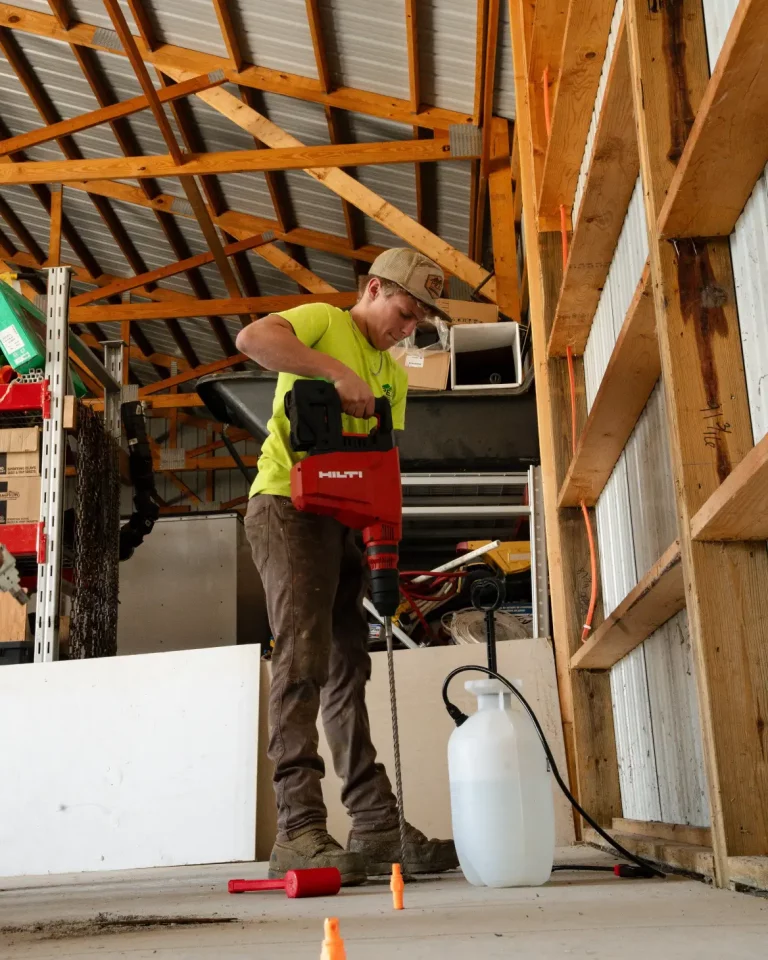
Once the plan is in place, small access holes are drilled through the sunken concrete. In polyurethane foam lifting, these holes are typically 5/8 inch in diameter, far smaller than the two- to three-inch holes required for traditional mudjacking. The smaller hole size reduces the risk of weakening the slab and means fewer visible patches after the project is complete.
Drill locations are spaced at planned intervals, often every few feet, depending on the size and condition of the slab. Our crew works carefully to avoid embedded rebar, utility lines, and control joints that could complicate the injection process.
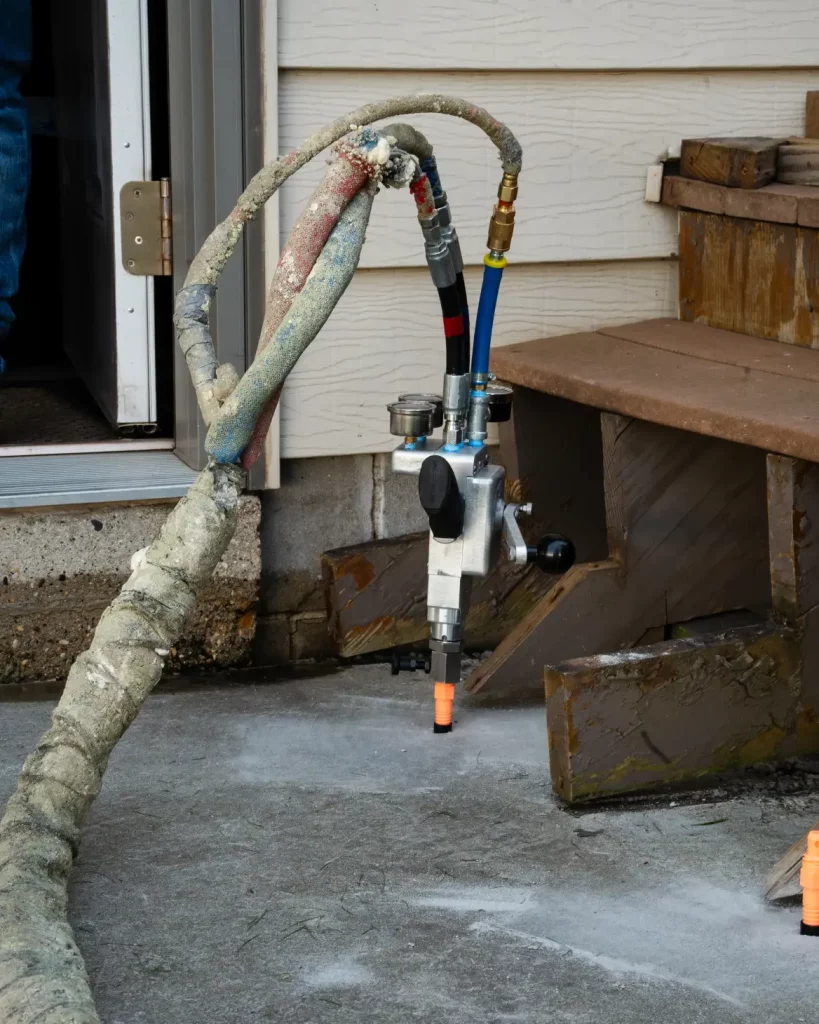
The injection phase is where the actual lifting occurs. Polyurethane foam, delivered as a two-component liquid through a truck-mounted pumping unit, is injected under pressure through the drilled holes. The components mix at the nozzle and begin reacting immediately, expanding into a rigid foam that fills voids and exerts upward pressure on the slab.
Research by the Oregon Department of Transportation on injected polyurethane slab jacking found that the foam can penetrate openings as small as 0.125 inches and consistently fills all openings 0.25 inches or larger. This ability to flow into tight spaces is what allows the material to thoroughly fill voids beneath the slab, providing stable, long-term support.
Key aspects of the injection phase include:
The Wisconsin Department of Transportation, in its multi-year evaluation of polyurethane pavement lifting, confirmed that the material reaches 90% of its maximum compressive strength within 15 minutes of injection. This rapid cure time means the repaired surface can typically return to normal use the same day.
After injection is complete, excess foam is cleared from each access hole. The holes are then sealed with a non-expansive cementitious grout that blends with the surrounding concrete. The Oregon DOT study emphasized that properly sealed injection holes showed no signs of damage after two years of traffic exposure, while unsealed holes experienced raveling and deterioration over the same period.
The final step involves a thorough cleanup of the work area. Our crew removes all equipment, debris, and excess material, returning the site to its original condition with the exception of the now-level concrete and the small patched drill holes.
| Phase | What Happens | Typical Duration |
|---|---|---|
| Assessment and Profiling | Elevation measurements, crack inspection, injection planning | 30 to 60 minutes |
| Drilling | Small (5/8 inch) access holes drilled at strategic intervals | 30 to 90 minutes |
| Injection and Lifting | Polyurethane foam injected under controlled pressure; slab raised to target elevation | 1 to 4 hours |
| Patching and Cleanup | Drill holes sealed with grout; site restored to pre-project condition | 30 to 60 minutes |
While both polyurethane foam lifting and traditional mudjacking follow the same basic sequence of drilling, injecting, and patching, the materials and execution differ significantly.
| Feature | Polyurethane Foam Lifting | Mudjacking (Slurry) |
|---|---|---|
| Hole size | 5/8 inch diameter | 2 to 3 inches diameter |
| Material weight | Lightweight foam | Heavy cementitious slurry |
| Cure time | Approximately 15 minutes to 90% strength | Several hours to cure fully |
| Void filling | Expands to fill small openings and cracks | Fills only areas near injection point |
| Water resistance | Closed-cell structure resists water infiltration | Porous material absorbs water over time |
| Additional weight on subgrade | Minimal | Adds significant weight |
The lighter weight of polyurethane foam is a meaningful advantage in areas where soil conditions have already caused settlement. Adding heavy slurry beneath a slab can contribute to further compression of the subgrade, partially negating the benefits of the lift.
Concrete lifting involves working with pressurized injection equipment, drilling machinery, and chemical materials that require proper handling. Under OSHA’s concrete and masonry construction standards, workers applying cementitious or chemical mixtures through pneumatic hoses must wear protective head and face equipment. Additional safety measures include:
Our team follows these safety protocols on every project, ensuring the work area remains secure for both our crew and anyone nearby throughout the process.
Once the injection and patching are complete, the repaired surface is usable within hours. The slab should sit flush with adjacent surfaces, eliminating trip hazards and restoring proper drainage flow. Any standing water that previously pooled in low spots should now drain as originally intended.
Research from multiple state DOTs indicates that some minor settling may occur after lifting. The Oregon DOT monitored lifted slabs for two years and observed maximum settling of approximately 0.4 inches, with most settling occurring within the first three months. The Wisconsin DOT noted slight dips during informal ride quality surveys after one year, though ride quality remained better than pre-lift conditions.
To maximize the long-term results of a concrete lifting project:
| Property Type | Recommended Focus | Key Considerations |
|---|---|---|
| Residential driveways | Trip hazard elimination, drainage correction | Check for settlement near garage approaches and sidewalk connections |
| Commercial sidewalks | ADA compliance, liability reduction | Even small elevation changes can create compliance issues |
| Garage and warehouse floors | Load-bearing capacity, joint alignment | Monitor for differential settlement between sections |
| Pool decks and patios | Water drainage, aesthetic matching | Injection pattern planning helps preserve decorative finishes |
| Bridge approach slabs | Transition smoothness, void filling | Multiple DOT studies confirm effectiveness for this application |
Choosing a qualified professional makes a significant difference in the outcome of your project. Look for these indicators:
At Peak Spray Foam Insulation, our experienced team provides professional concrete lifting services to homeowners and property owners throughout the Albertville, MN area. We assess every project individually, recommend the most effective approach for your specific situation, and complete the work with minimal disruption to your daily routine. Whether you are dealing with a sunken driveway, uneven sidewalk, or settled garage floor, we have the expertise and equipment to restore your concrete to a safe, level position.
Request a Quote | Schedule an Assessment
Call us at (612) 482-4742 or email [email protected] to discuss your concrete lifting project. We will evaluate your property, explain exactly what to expect, and provide a clear path forward.
Most residential projects are completed within a single day, typically ranging from two to six hours depending on the size of the area being lifted and the amount of material required.
The polyurethane foam used in the lifting process reaches approximately 90% of its full compressive strength within 15 minutes of injection, so normal foot and vehicle traffic can usually resume the same day.
In Albertville and across Minnesota, the primary cause is repeated freeze-thaw cycles that crack and weaken concrete, combined with water erosion of the soil beneath the slab that creates voids and allows uneven settlement.
Concrete lifting is less invasive, costs less, and can be completed in hours rather than days. It also preserves the existing concrete rather than generating waste from demolition and disposal.
The small access holes are sealed with cementitious grout that blends with the surrounding concrete. Over time, weathering further integrates the patches into the surface, making them difficult to notice.